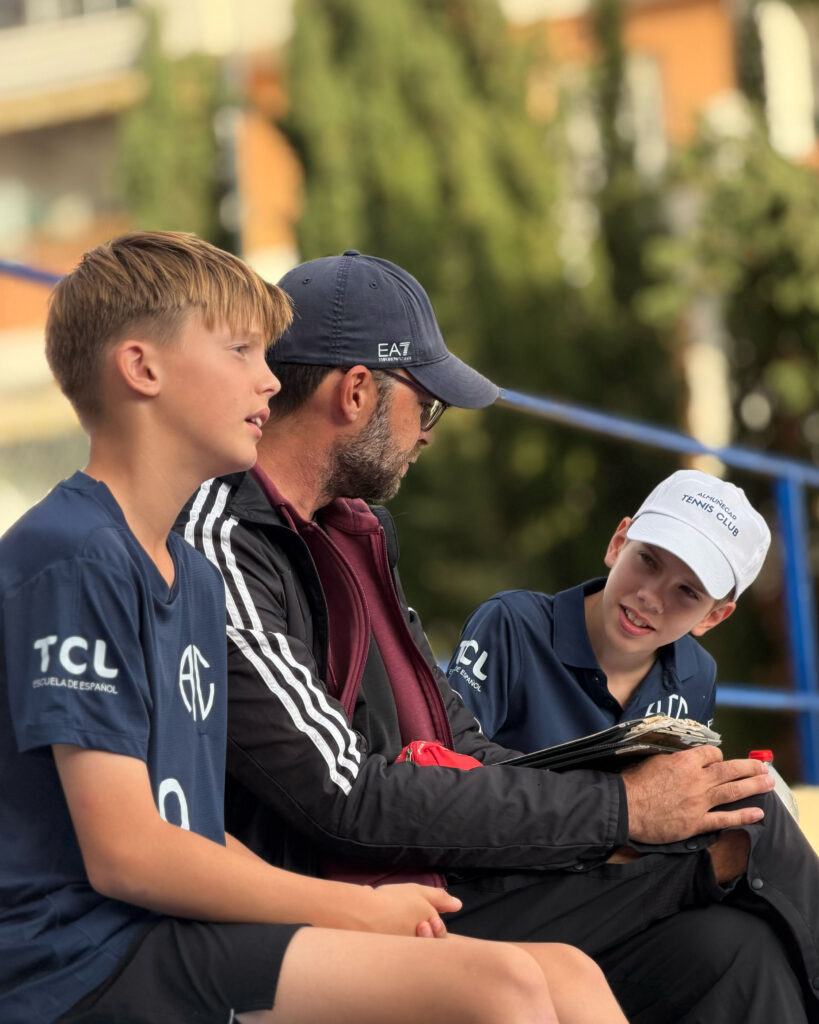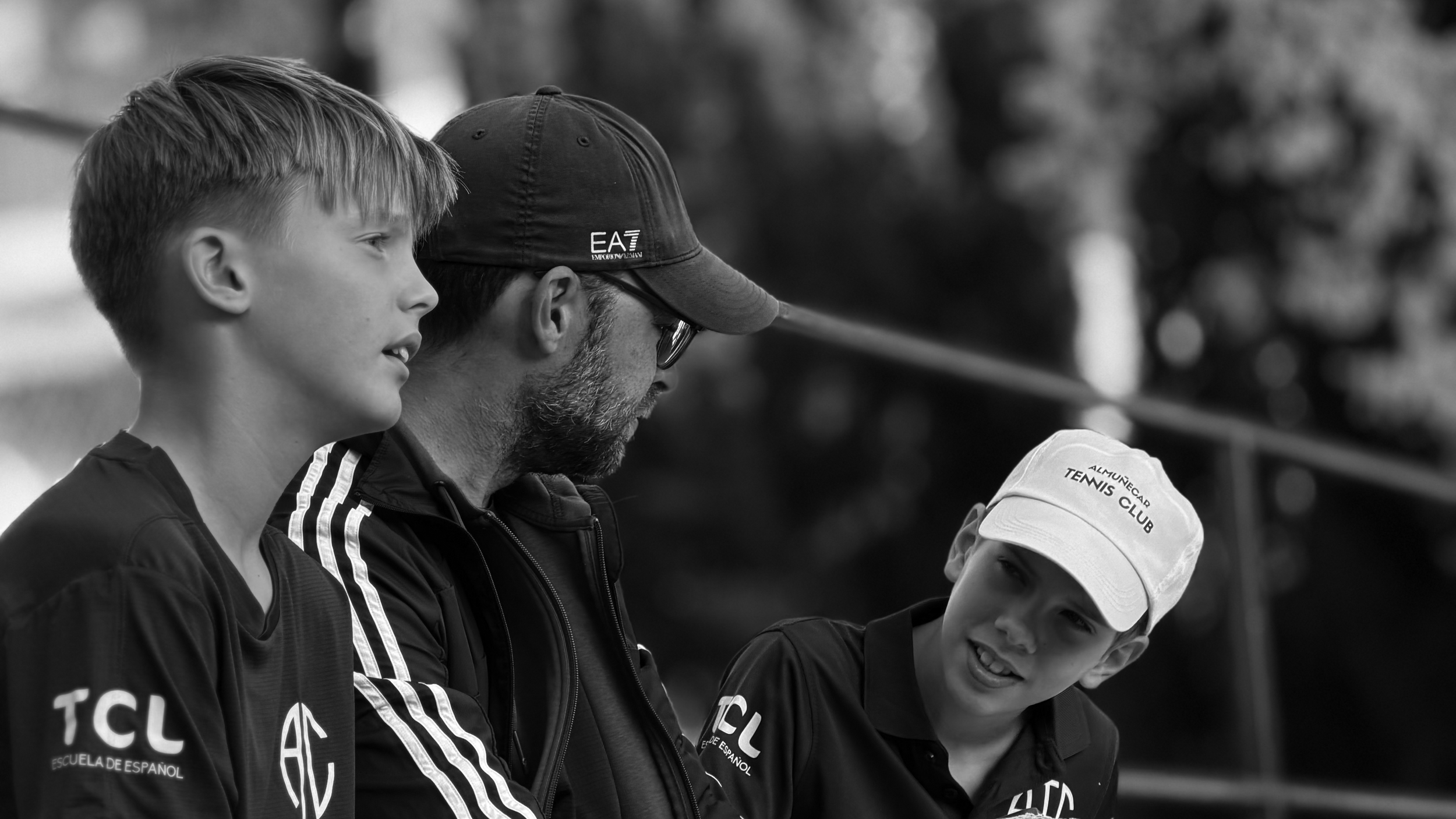
While looking through some photographs from a training camp organised by Almuñécar Tennis Club, I came across one that particularly caught my attention. There I was, with my white beard, sitting next to two very young tennis players. One was looking at me with an inquisitive smile, almost as if he were waiting for an answer or trying to understand something. The other had his gaze fixed in the distance, towards the sky, with his eyes looking ahead.
Looking at that photograph, I felt a great sense of satisfaction.
Not so much because of the work we had done during those days, but because of what the image represents to me. It captures the meaning of a professional decision that, over the past few years, has required a great deal of work, reflection and, above all, a fair amount of courage: shifting my attention away from elite sport alone and returning to investing in young athletes.
A decision that feels increasingly right to me.
Feel good when starting from scratch.
Working in elite sport allowed me to experience the international sporting world at close quarters and understand just how much work, expertise and sacrifice it takes to reach that level.
And yet, I cannot deny that the past decade has left me with an increasingly strong sense of disappointment. Not so much because of sporting results — those have always been there — but because of what I have observed on a human and psychological level. I have seen young people with great ability, seemingly unshakeable, struggling more and more to cope with expectations, external pressures and an environment in which appearances seem to have taken on a disproportionate importance.
Sometimes, when the bigger picture becomes too confusing, full of corrections and contradictions, the best solution is to stop and start again. Not because everything that has been done has no value, but because continuing to build on foundations that are not particularly solid risks making the whole process increasingly complicated.
Starting again with young athletes means precisely that: trying to build something different, paying greater attention to the foundations. It means working towards developing athletes capable of achieving important results, but also healthy, self-aware individuals with strong ethical principles.
Because we do not simply want to contribute to developing the most competitive athletes possible in the future. We want to help develop people who can sustain the journey required to become them.
The immense beauty of working with young people.
These young players reminded me just how different two athletes of the same age, playing the same sport, can be. Different in the way they learn, approach difficulties, respond to mistakes and interpret competitive situations.
And yet, when I observed them, one thing stood out as common to both: enthusiasm. The desire to learn, to win, to improve and to understand what the next step might be.
It is something I recognise beyond sport, too. When we dedicate ourselves seriously to an activity, whether it is studying, working or practising a sport, sooner or later we find ourselves confronting who we are. We want to understand what we are capable of, improve and achieve something we can feel satisfied with.
In young people, this drive can emerge particularly spontaneously. Their relationship with tennis is closely connected to what happens on the court: a point won, a point lost, a new situation to deal with, something to learn.
There was no need to constantly construct an image of themselves. They simply had to play. Play to win.
And that is precisely the dimension I would like to protect for as long as possible.
When appearances take the place of substance, serious problems begin.
I have nothing against athletes having a digital presence. On the contrary, I am fully aware of how important it can be for their professional future. Anyone aspiring to compete at a high level will increasingly need to build relationships, find sponsors, secure representation and create financial opportunities that allow them to sustain the costs of their sporting career.
We do not live in a fairy-tale world. Professional sport requires financial resources and, today, a significant proportion of those resources also comes through an athlete’s public image.
The problem begins when that image stops being a tool and becomes an objective in itself. When a young athlete starts measuring their own worth through followers, views or the number of posts they publish, they risk gradually losing touch with what should remain at the centre of their activity.
A tennis player is developed on the court, point after point, match after match. They win, lose, learn and return to training. Their sporting value is not measured by the number of people following them on social media, but by what they are capable of doing when they step onto the court.
An image can tell the story of a result, help give it visibility and create opportunities. But it cannot replace the result itself.
Sooner or later, when the time comes to confront their actual level, appearances give way to substance.
The future will reward those who know how to rise above the rest. The others will fight over the scraps.
While I continue to receive suggestions about the need to make ten-second reels explaining the three fundamental exercises for running the 100 metres in under eleven seconds, I keep writing. Writing, writing and writing. So that people can read, read and read. And I keep observing what happens on the field.
I believe that, over the next few years, one of the most important differences in sport will come down to the ability to gather information, understand it, process it and turn it into effective behaviour. Concentration, the quality of learning, the ability to sustain attention and adapt to different situations will become increasingly important resources.
We cannot expect to protect young people simply by banning them from the digital world. We need to teach them to understand it, use it and recognise the opportunities it offers, without becoming dependent on it. We need to help them understand when a tool is useful and when, instead, it risks taking time and energy away from what really matters.
My aim is not to create young athletes who are disconnected from the world they live in. It is to help them grow with the ability to choose how they engage with it, maintaining their own identity and not allowing external expectations to define them.
Building people with winning qualities first and foremost.
Looking at the photograph again, I feel that the contrast between my white beard and the two boys’ expressions captures something rather beautiful. On one side, there is experience. On the other, two young people with an entire journey still ahead of them.
I do not know where tennis will take them. I do not know what results they will achieve or which paths they will choose. But I do know that they reminded me why investing time and energy in the next generation is worthwhile.
I would like to thank Almuñécar Tennis Club and its head coach, Gerónimo, for this experience and for the work he is doing to identify and develop young talent.
To him, and to all the professionals who dedicate themselves to the development of athletes every day, I wish a bright future. One in which success is measured not only through results, but also through the quality of the people they have helped to develop.
Athletes who are psychologically healthy, capable of facing difficulties, aware of their responsibilities and grounded in strong principles. Strong, well-prepared athletes who are, on the court, utterly formidable competitors.
Because the future of sport does not begin when a young talent turns professional. It begins much earlier, with the kind of people we choose to help them become.